A while back I texted one of my best buds, Don, who I used to skate with, saying I was thinking about starting up again. My concern, I told him, was that every time I would go for a run, I couldn’t convince myself to hurl my body at the ground, so maybe I wasn’t ready.
When I finally did start skating again, I was reminded that it can be embarrassing to get in front of everyone, not be very good, and fall on your ass a lot. And as I just realized my largest loss ever in the market, I’m here now to fall in front of you this month.
I heard Tony Hawk say in an interview, “I don’t like getting hurt; I’m just not afraid to,” and I like that.
I’m not one of those “pain doesn’t bother me” dudes. Pain, both physical and emotional, hurts and I avoid it just like most rational people. Problems can arise from too much avoidance and not leaning into some discomfort from time to time.
I can remember early on having to spend a whole weekend wondering if I was cut out for trading after dealing with several large losses. There have been times where I thought about not skating or continuing this site because of the struggles that I have to overcome each time.
I can tell myself that I’m not very good or that things aren’t coming easily or quickly enough to me. We all deal with this form of self-talk, so it’s important to recognize it and have a plan for how to deal with it.
Don’t just blindly accept it. Maybe even try to prove it wrong.
All Pain, No Gain
Okay, so usually, when I’m talking strategy on here, I’m referring to the selling of options. What we’re about to discuss is buying options and the dangers associated with doing so.
With this being a riskier strategy, and one that I obviously haven’t figured out yet, I have chosen not to explain or recommend it on this site as of now. I hint at it from time to time as some of my biggest wins this year came from buying calls. But as we’re about to see, it’s also the cause of my largest loss ever.
Here’s the drama. Bezos dumped a bunch of his Amazon stock, causing the price to dive back in September. These things happen, and sometimes they’re even planned well in advance as was the case here, so I jumped in thinking it was a good entry point.
So far, so good – except I make two small adjustments to my trading plan.
You see, I have the tendency to get a little nervous sometimes and close out these types of trades for a quick profit early on, only to watch them continue to go in my favor, essentially leaving money on the table. A common phrase you’ll often hear is, “Let your runners run,” and I was attempting to adopt it as I tired of feeling the FOMO.
Secondly, I had also picked up a little tip on how to slowly add on contracts over the course of weeks or months instead of going in heavy all at once, thinking I had timed it perfectly. It was described as dating the contract for a little bit, adding on one or two here and there as things move around, before committing and marrying it after some time, once the trade has proven to be successful.
These two seemingly harmless changes created a perfect storm in my portfolio that I didn’t have the sea legs for.
I slowly added on contracts, but sorta lost track as I was doing this between two different accounts. Before realizing it, I was over-leveraged. I had opened too many contracts and had way too much money at risk. To my credit, I did close half of the position in advance, but chose to let the other half ride. I bought these in September and they expired in January, leaving me to believe I had plenty of time.
But time comes for us all.
At the end of October, an earnings report was released and Amazon has great news for investors, causing the stock to skyrocket and the calls I bought were now at a profit of around $7,500, a return of 150%!
My thought process was that, surely now investors will pile in as it’s been riding the bottom for a bit. Lots of articles and several analysts raising their price targets by +$50, not something you see very often! Everyone and their mama was talking about how undervalued it was.
“The markets can stay irrational longer than you can stay solvent.” – John Maynard Keynes.
Then suddenly, for some reason, the nation seemed to collectively remember that our President was besties with our #1 pedophile. I was under the impression that we’d known this for a while. In the past few months, the markets have been temperamental as people seem to disagree with that relationship, understandably.
So what started as a $7,500 gain turned into a $4,606 loss. This is, no doubt, a hard lesson, major setback, and something I won’t soon forget. I’ve been in this play since September, so that’s a lot of ups and downs and what ifs that I’ve been dealing with on a daily basis. I’m glad to get this over with.
Me IRL
I have a renewed love for the safety of selling options after this experience. In November I said, “Some people only sell Cash Secured Puts far below the stock price in an attempt to never get assigned, effectively using only their cash to make money without owning shares. This is cool.” And this is exactly what I’ve been doing and I’m back to pulling in consistent profits again.
We’re gonna fail, that’s inevitable. What’s important is what you do afterwards.
In unrelated news, do YOU want to learn how to become a Hot Shot Options Trader?! Purchase one of my courses to unlock the secrets that hedge funds don’t want me to tell you!!
SIGN UP NOW!! PLEASE!!
“The fool who knows his foolishness is wise at least to that extent, but a fool who thinks himself wise is a fool indeed.” -Dhammapada, a collection of sayings by the Buddha.
Bio-Dome
There was a $150 million experiment in the 90s where they tried to simulate our ecosystem in a biosphere in the Arizona desert. It was a prototype for a future colony on Mars.
The environment thrived in the beginning. With everything under complete control and away from the chaos of the real world, they experienced vigorous growth, with many plants exceeding expected sizes.
But, what they soon discovered was the daily chaos of our environment was actually beneficial for the ecosystem. They found out the hard way that trees need wind to stay strong. Trees develop what’s known as stress wood, or reaction wood. When stressed by wind or other foreign objects, they trigger a change in their cellular structure in order to grow this stronger wood. This leads to their resilience.
The roots also suffered from what they called, “lazy root syndrome.” When wind pushes against a tree it creates tiny tears and stresses at the base of the trunk and in the roots. This causes the tree to send down extra nutrients and growth hormones to thicken the roots and push them deeper into the soil to anchor the tree. In the windless dome, this didn’t happen, causing the roots to stay shallow and weak.
The trees couldn’t stand on their own and the project was a failure.
You see my point with all this. Weave discomfort into your life.
Monthly Roundup
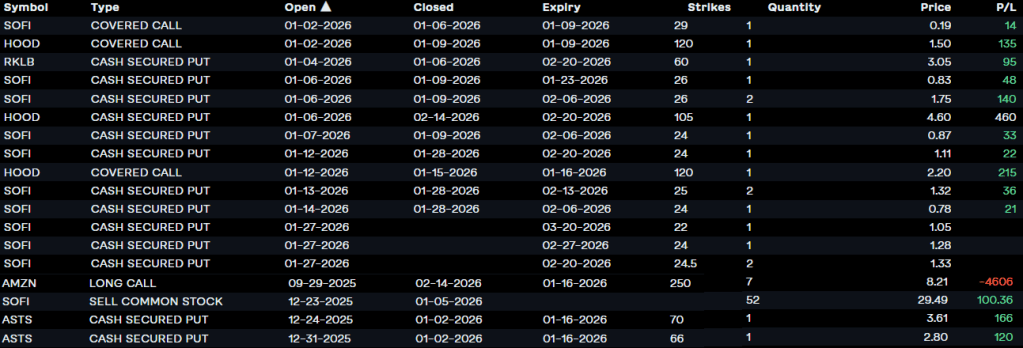
In January, I made… oh, wait, I’m down $3,461.
I made $1,145 but I gave back $4,606.
Here are the trades. As you can see, I sold a lot of Cash Secured Puts this month in an attempt to crawl my way back out of this hole.
Clicking the image will take you to my Theta Gang profile where you can view more details and notes on all of my trades.
I may not be green in the markets, but I’m green on the news!
So needless to say I’m at odds and ends. But I’ll be stumblin’ away, slowly learning that life is okay. Say after me, It’s no better to be safe than sorry.
Take on me, Chris
Lend as little as $25 to create a more equitable world.Donate directly to the poor.
If you’d like to give trading on Robinhood a try you can click my referral link HERE and we’ll both get some free stock.
Back in this post, I wrote about some of my daily rituals. Well, wouldn’t you know it, I’ve tacked on a few more things since that post, and one of them is journaling. Like the other things I listed, I’ve journaled for a while and can clearly see the benefits from it, but can be inconsistent, so I made it a daily must-do.
I like looking back and seeing how different my life was, even just a short time ago. It can remind me that I’ve gotten out of impossible situations or have freed myself from negative thoughts or emotions countless times before. I only recall it now because I chose to write it down in an attempt to work it out in the past.
Our perspective changes as we go through new and different experiences. The way out of the wilderness seems so obvious in hindsight. But, this can be difficult to realize if you’re not keeping track of where you’ve been along the way.
I’ve really grown to appreciate journaling daily these past 3 months. If you know me personally, you know that my short-term memory is not the greatest, so it’s been a relaxing and handy exercise to go back through my day and evaluate it. I will say, my gratitude has increased exponentially since I started. Taking a moment to recognize how neat and entertaining life is reminds me that there is really a lot to be grateful for. My awareness and appreciation of some of the minor details and interactions in my day to day life has also improved.
In a similar vein, I’ve thought of how my trading has changed as we head into a new year. Having a record of my trades and run-on sentences serve as a reminder of how far I’ve come and helps me learn from my past mistakes.
There was a time where I was consuming a lot of information in the realm of finance. When I first discover something new and intriguing, I tend to dive in head first and become a little obsessed until I have a good understanding of it. I then continue doing the thing but with the burner turned down a little, bringing things to a steady simmer.
So I can see times where I over-traded simply because I was thinking about trading too much. The podcasts I listened to, the books I read, and the TV I watched all soon shared the same common theme. Sometimes I would find myself thinking about stocks while doing my yoga routine or meditating, making me aware that I was becoming a little unbalanced and needed to make some adjustments.
People often say, “money is the root of all evil”, but that’s not the whole quote.
“The love of money is the root of all evil.”
“Feed me, Seymour!”
I’ve done a lot of soul searching on whether I wanted to continue this blog for another year. Honestly, this whole stock market and writing on a website thing is pretty out of character for me. I only make it look easy.
But, I simply cannot deny that I have become a better trader by openly journaling my thoughts, goals, and process as well as my ups and downs throughout the year. There’s magical power behind saying what you’re going to do and then following through on it. When you keep at it the Universe seems to take what you say and what you want a little more seriously.
As I speak, I create.
This whole project has helped me continually refine my system, and the reminder that I must stand in judgement in front of you each passing month has kept me honest and accountable.
And, though, I wrestle constantly with writing and this site and all the silly things that go into it, I know that these little challenges can really help us thrive when we make the choice, each and every time, to push through them. I also sincerely hope, in the process, that I’m able to save you some trouble and maybe get your gears turning a little.
If you don’t take a moment to reflect, circumstances will force you to reflect.
Roll Back Prices
How about one last little lesson to close out the year?
There’s another really good reason to sell options that I haven’t really discussed and I want to take a minute to go over that with you if you’ve got a sec. By selling options on stocks you own or want to own, you are effectively lowering your cost basis each time.
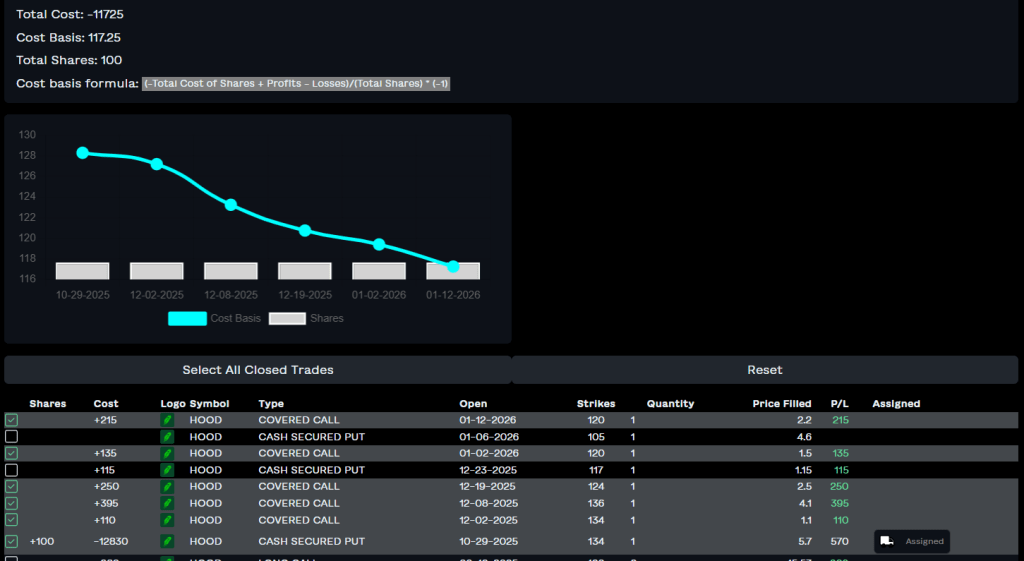
Cost basis tracker tool from ThetaGang.com
This here just shows me how my cost basis decreases as I continue to sell options on a stock. In the picture of the tracker above, starting at the bottom, you can see I sold a Cash Secured Put on HOOD at the $134 strike and received $570 in premium for doing it. The stock’s price was below $134 when the option expired so I was assigned and forced to buy 100 shares for a grand total of $13,400.
But, because of the $570 I received in premium for selling the Cash Secured Put option, that actually drops my initial cost to $128.30 per share, a total of $12,830 vs the original $13,400.
As the stock price recovered, I began selling Covered Calls against those 100 shares. Each time I have avoided assignment, keeping the shares and most of the premium.
You can see that, in total, I’ve collected $1,105 so far from those Covered Call premiums. Doing so has dropped my cost from $134 a share to $117.25 a share. You could essentially do this until your cost basis is $0 if you kept at it.
You’ll also notice in the picture that I was able to lower my strike prices down on my Covered Calls as my average cost lowered. I started by selling calls at the $134 strike (the price I was originally assigned the shares) and I’m now selling at the $120 strike. This allows me to bring in more premium as I’m selling closer to where the stock is currently trading.
Lastly, you’ll see that I also keep selling Cash Secured Puts on HOOD at the same time as I’m selling Covered Calls to bring in even more money. This allows me to simultaneously capture premium on both sides of the stock’s price action.
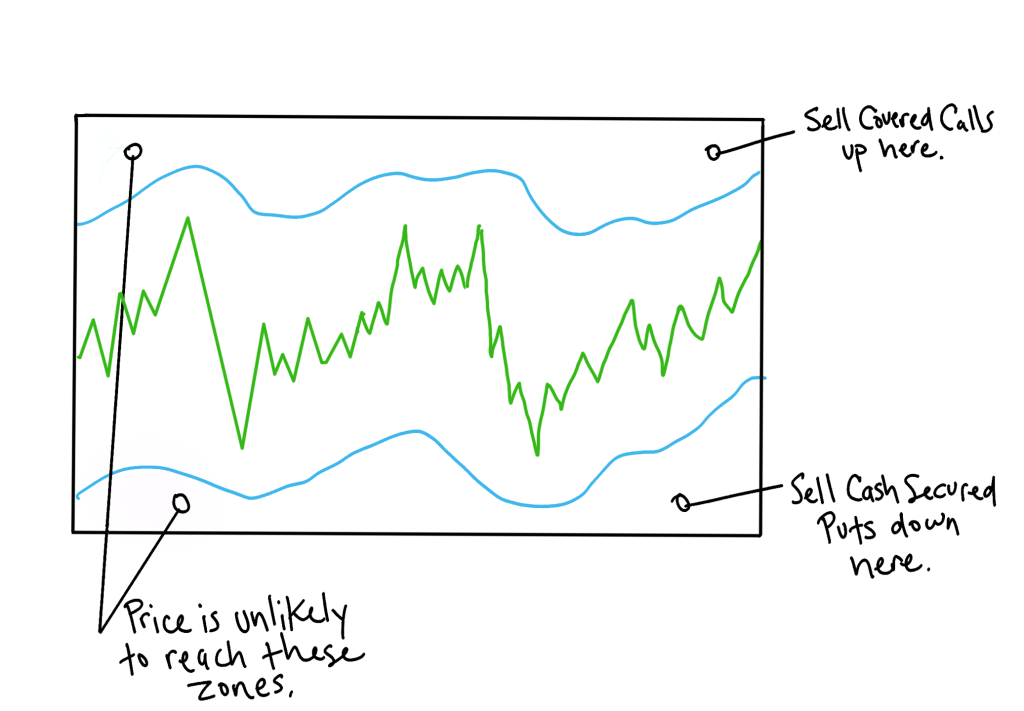
By using the techniques and indicators I laid out in this post with the wisdom of deltas that spilled forth from me in this post, I’m able to simply use probabilities to make money by selling options in the price ranges that the stock is less likely to reach.
This is another example of my weird little analogy of how these stocks can act like little businesses for you. In just over a month I’ve already made $1,105 from selling Covered Calls on a stock I own and that’s money that I could just pull out and do whatever with, or leave in the account to invest and compound.
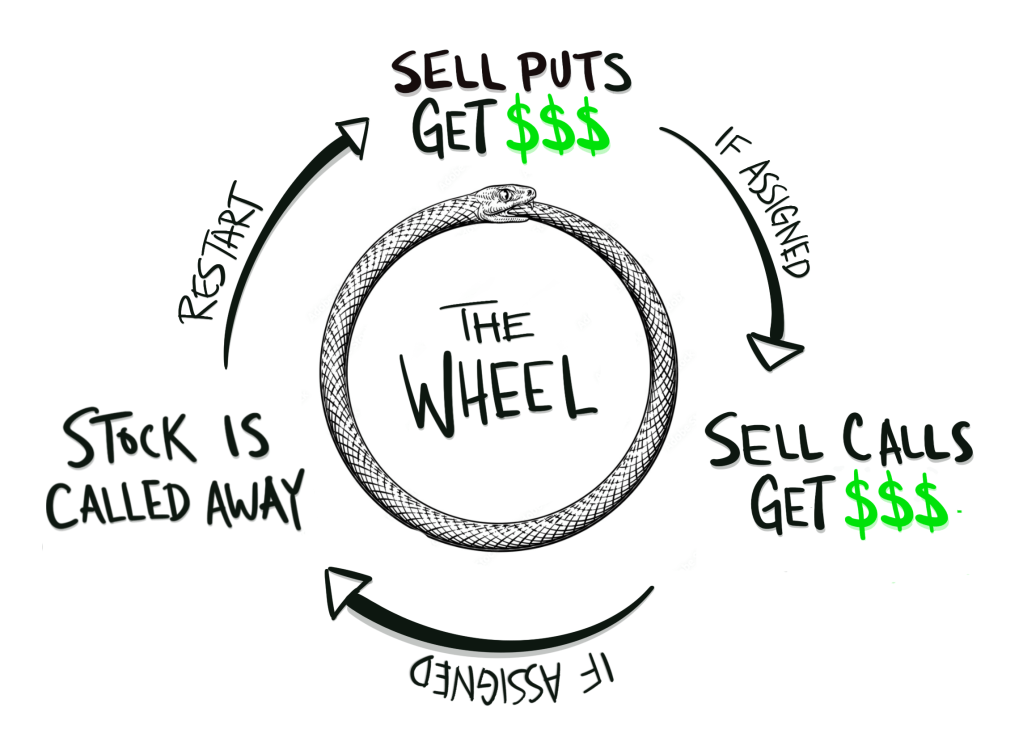
You’ll probably see me use this picture several times on here. I made it, I think it looks cool, and I think it’s a nice visual representation of what I’m doing here.
Sell Cash Secured Puts until you’re assigned and have to buy 100 shares. Then you sell Covered Calls until the shares are called away. Collect premium at every stage. Rinse and Repeat.
Monthly & Yearly Roundup
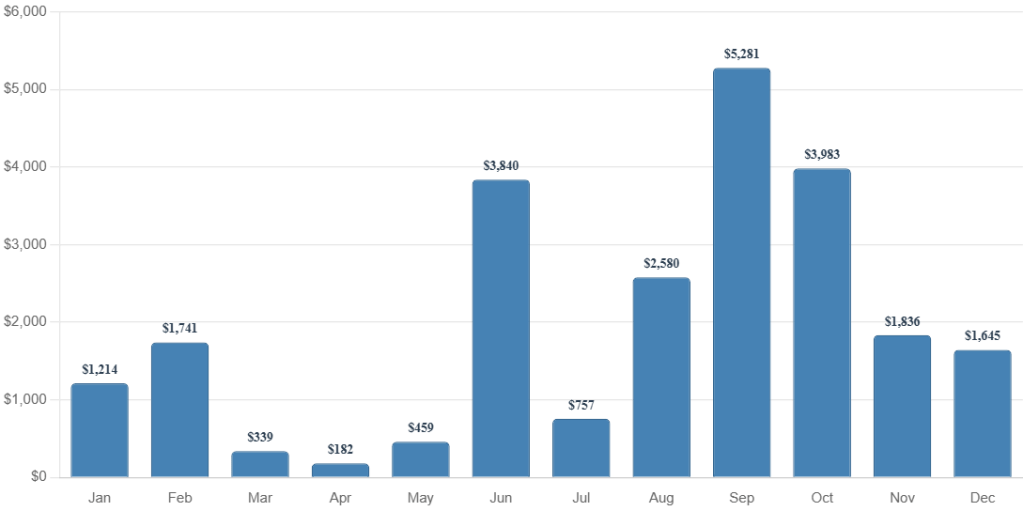
In December I made $1,645.
And I’m very pleased to report my total earnings of $23,857 in the year of our Lord 2025. I did not start out with any sort of “I wanna make X amount this year” goals, to me that’s dangerous as it could lead to forced trades. But, if you would’ve asked me to guess at the beginning of the year what my grand total would be, my number would’ve been well below that.
Needless to say I’m feeling optimistic for next year, regardless of market conditions.
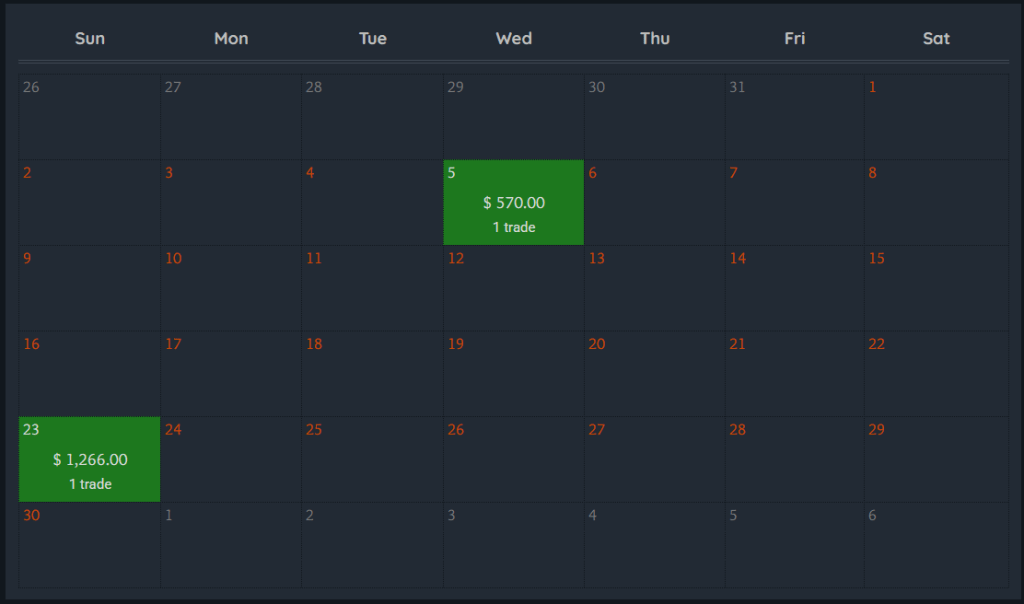
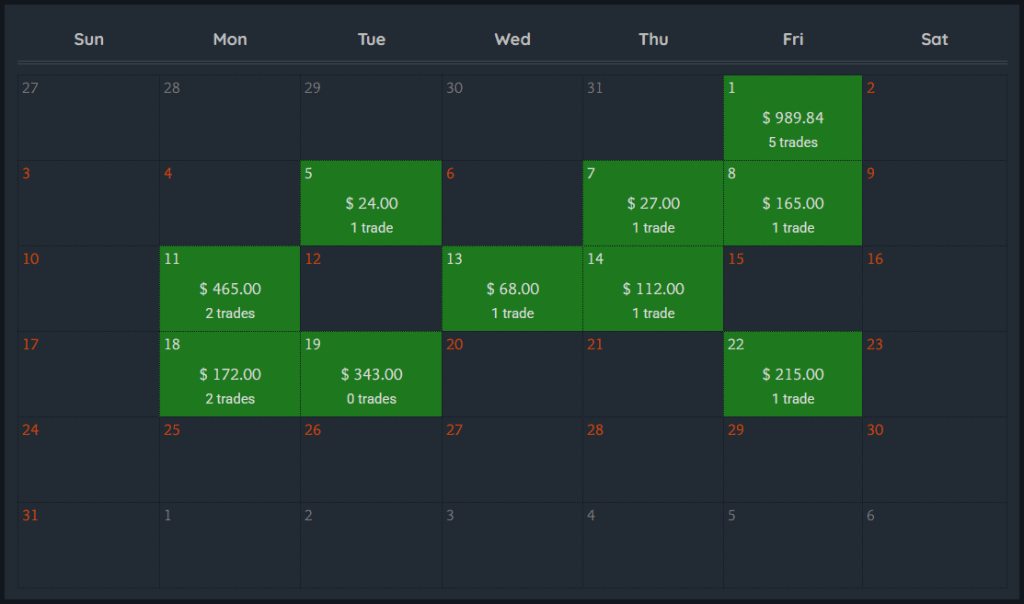
Profit and Loss Calendar for December
Here are the trades .
Clicking the image will take you to my Theta Gang profile where you can view more details and notes on all of my trades.
Here’s a table of my monthly performance.
Well, that’s a wrap for 2025.
Shout out to all my readers! I’m genuinely shocked by how many people look at this thing. It wouldn’t be as fun and would be way more sad without you here. I also owe Becky a huge thank you. She’s always there to let me ramble and flesh things out for as long as I need to on whatever topic I’m currently obsessed with. I couldn’t ask for a more supportive partner and she’s a constant inspiration.
See ya next year! Chris
Lend as little as $25 to create a more equitable world.Donate directly to the poor.
If you’d like to give trading on Robinhood a try you can click my referral link HERE and we’ll both get some free stock.
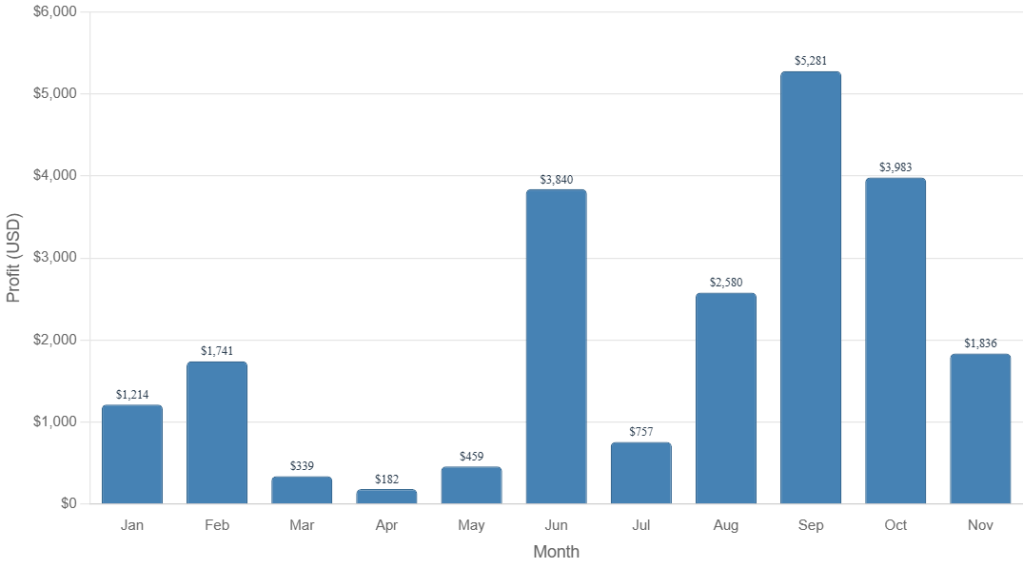
I’ve increased my accounts by $21,119 in the year of our Lord 2025.
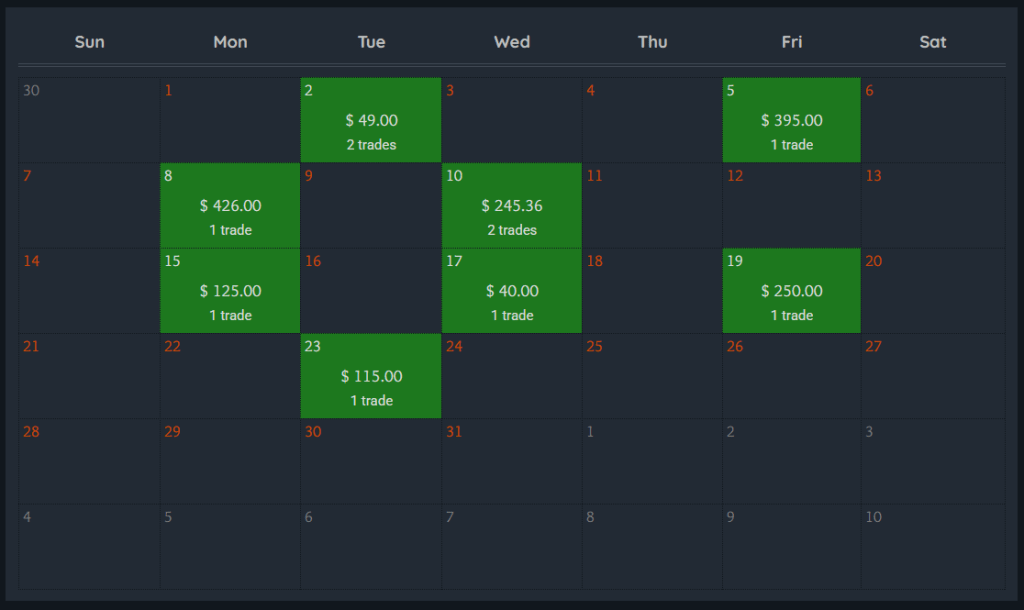
Profit and Loss Calendar for November
Here are the trades lol.
Clicking the image will take you to my Theta Gang profile where you can view more details and notes on all of my trades.
Here’s a table of my monthly performance.
High Achievers, Peep This
I’ll be going over two strategies today, Cash Secured Puts and Covered Calls, there’s a quick primer here if you’re not familiar with them.
I mentioned last month that things are feeling a little unstable out there. I have pivoted back into selling options and attempting to trade more strategically as I sense the environment shifting. But, please keep in mind that I don’t know anything.
What I’d like to walk you through on this episode is The Wheel Strategy. It’s a combo of two strategies when you sell puts until you’re assigned shares, then you sell Covered Calls until they’re called away. Then you start over and repeat the process. The Wheel is about as safe as it comes in the world of options trading.
I’m going to discuss these strategies, walk you through a few scenarios so you can see why and how you would use them together, as well as some tips on how to glance at a chart to determine the best option to choose and when to execute a trade.
Here’s some brief definitions of some vocab that may be new to you.
Assignment happens when you, the option seller, are forced to complete the trade, either selling your shares or buying shares.
Strike Price is the specific price per share at which the underlying stock can be bought (for a call option) or sold (for a put option)
Premium is the immediate cash payment you receive from the option buyer for taking on the obligation of the contract, and it is the maximum profit you can make on that trade when you are the option seller.
Tryin’ to Make a Livin’ and Doin’ the Best I Can
Cash Secured Puts pay you a premium for agreeing to buy a stock if it is below a specified price by its expiration date. They allow you to generate income while giving you the opportunity to buy stock at a discount. They are a low-risk, high-probability trade.
Once I am assigned and own the shares, I wait for the price to recover. When the price rises back near the original price that I paid for the shares, I get paid to sell Covered Calls to sell the shares to someone else. These are also a low-risk, high-probability trade. They generate income while also hedging for a slight decline in a stock’s price.
By doing this, I’m essentially renting stocks and using them like a little business for making money by selling options around their price action, and am not as concerned about the stock’s price. Which will hopefully make more sense after I do some rambling.
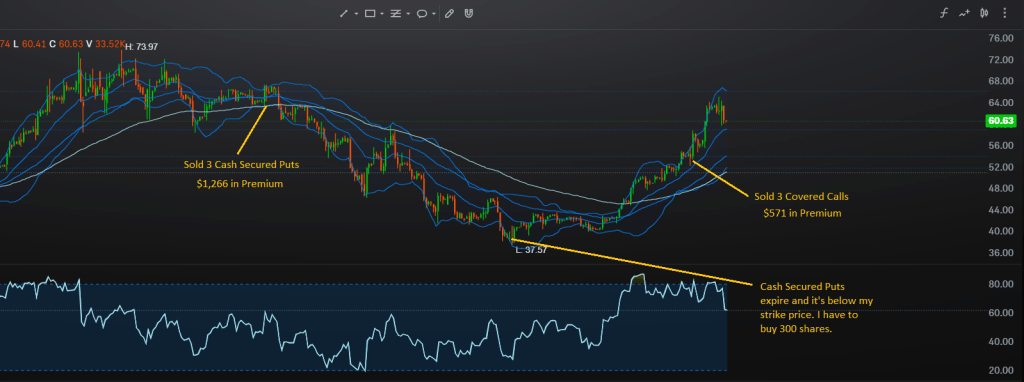
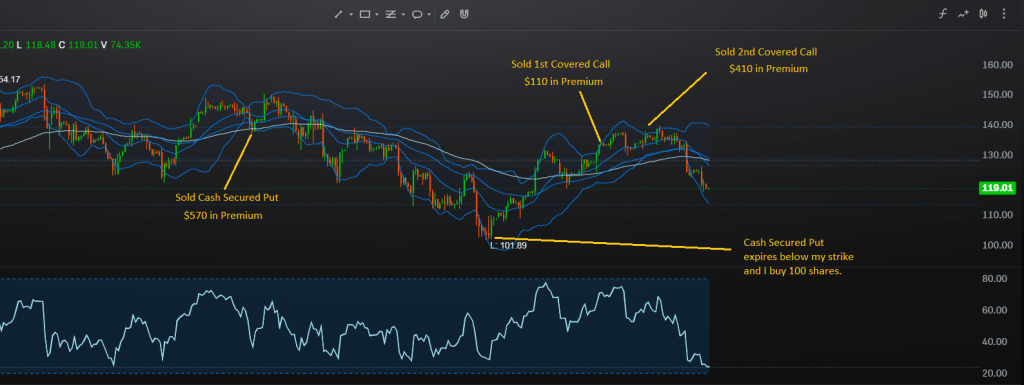
In these two examples I’m about to show you, my only two trades this month, you can see how I was pretty off on the timing when selling the Cash Secured Puts, as the stock went way down afterwards. In both cases, on the day the contract expired, the stock just so happened to be at it’s lowest point. Ideally that is where I should’ve sold the puts. I perfectly timed the bottom in a hilariously dumb way.
But I can’t tell the future and this just shows that you don’t have to get the timing or direction right to be profitable with these strategies. This gives you a major advantage.
This first example is for Rocket Lab (RKLB). I sold 3 Cash Secured Puts at the $59 strike price that expired in one month while the stock was trading for around $65. This means that if the stock price is at $59 or below in one month, I am obligated to buy 100 shares at that price per contract, so 300 shares total for 3 contracts.
The reason I do this is because I wouldn’t mind owning the shares at that price and I get paid a pretty premium to sell the contract. $1,266 for 3 contracts in this case.
Again, when you look at it, I kinda did both of these trades at the worst possible time and I still made money. Therein lies the true beauty of selling options!
Now, you have to be able to stomach the downturn and have the patience to let the price rise back up before selling Covered Calls on the shares you now own. When you’re assigned on a Cash Secured Put, this ultimately means that something has happened and the stock price has dropped. More often than not, this means you have to buy shares for a price higher than they’re currently trading. This won’t feel great.
In the picture above, I agreed to buy those 300 shares for $59, so when the price dropped down to $37 that was a $6000 loss on paper, but not an actual loss, I just could have gotten them for cheaper if I were a little more psychic. All I did was wait for price to recover and now I’ve actually made $1,415 on the trade so far.
In the chart below, you’ll see I did the same thing with Robinhood (HOOD). While the stock was trading around $140-145, I sold a Cash Secured Put with a strike price of $134 that had a one month expiration. I was paid $570 to sell that contract. Afterwards the stock dropped way down and I was forced to buy 100 shares on the expiration date.
When I was assigned the HOOD shares I was forced to buy 100 at $134 while the stock was trading at $104. That’s a $3000 loss on paper from the start. I just had to be patient and let the price recover while doing nothing. Once it did in a week or so, I started selling Covered Calls against them to get rid of the shares. I’ve already made $520 in premium doing so.
In this way, I have bought a stock at $134 and sold it at $134, but have profited $1,090 so far. This is what I mean by using the stocks as more of a little business and making your money off of selling the volatility around the dramatic price action, if that makes any sense.
This takes a shift in your trading mindset and is something I’m still having to get used to. It feels unnatural. You’re not so much concerned about the stock price, but more concerned about how you can make money on their volatility and movement. You’ll ask yourself, “but what if the price goes up a little more”, and a thousand other hypothetical questions while trying to glean answers from your scrying mirror.
But you make money off the passage of time and wait for the bigger moves now. You’re not a boring buy-and-hold investor any more. You’re beyond space-time and hypothetical questions.
Not So Risky Business
I kinda just put a new heading there to help break up the whole thing and keep your attention. We’re still on the same subject. However, I do wanna switch it up and show you how you would go about selling options with the probabilities in your favor to suit your risk-adverse way of life.
When selling options, you can attempt to pick strike prices that you don’t think the stock will reach using probabilities that are clearly laid out for you in your trading platform.
For example, if you wanted to sell a Cash Secured Put on a stock but wanted the odds of getting assigned and having to buy the shares to be slim, you would look at the Delta of that option contract.
A contract with a .20 Delta means that there’s a 20% chance the stock will be at the strike price of your contract by expiration. So there’s an 80% chance that you won’t have to buy the shares and will simply get to keep the premium paid to you.
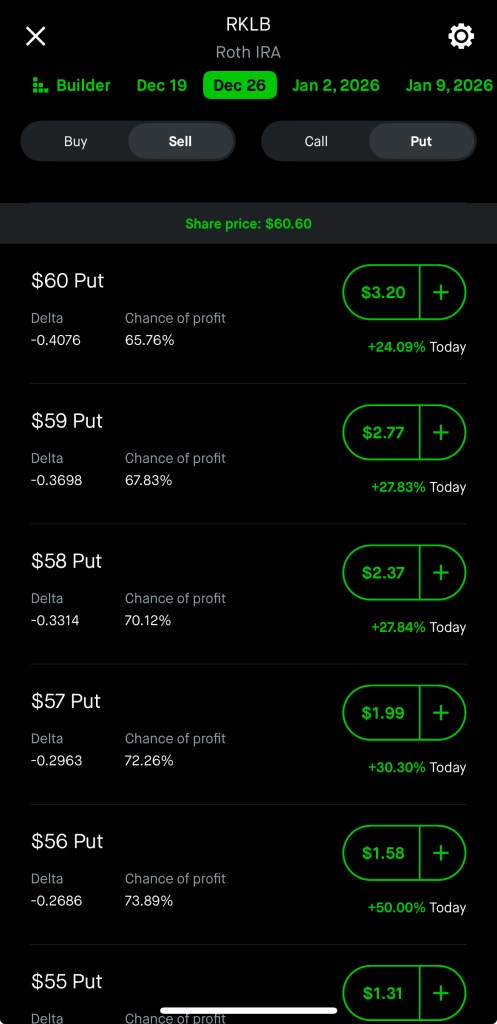
The higher the Delta of the contract the more premium is paid to you because the chances of it happening are greater. Here, let me show you what the option chain looks like on the Robinhood trading platform. This is where I get to pick and choose the contracts that I’m going to sell.
There are different dates to choose from at the top. Below that is a grey bar that shows the current stock price of $60.60. On the left are the different strike prices to choose from with the Delta listed beneath. The green numbers on the right show the premium I would receive for selling the contracts. That number is per share and each option contract is for 100 shares, so that $3.20 is $320.
So looking at that option chain, if I sold the $57 Put I would get paid $199 in premium. In two weeks, on Dec 26, if the stock price is above $57, I get to keep the $199. If the price is below $57 at expiration, I have to buy 100 shares at $57 regardless of what the current price is while also keeping the $199 premium. With a Delta of .29, there’s about a 30% chance of that happening.
This is where your personality and risk aversion come into play. I like to take larger, calculated risks, so I will often choose the contract right under the current stock price to get paid more. A strike price just below the current price is called “at the money” and you’re paid more for these because they are so close to the stock price, making the odds of you getting assigned pretty high.
Some people only sell Cash Secured Puts far below the stock price in an attempt to never get assigned, effectively using only their cash to make money without owning shares. This is cool.
However, you will notice as you retreat to the safety of the lower probability contracts that there is a trade off; you aren’t paid as much premium. With less risks, comes less rewards.
ting!
Keep in mind, we’re selling someone insurance when we sell a Cash Secured Put. You sold the put, so that means someone bought the put. The person on the other side of the trade owns the stock and bought the put option from you for the chance to sell to you should the price be below the strike price of the contract at expiration. I’ll understand if you need to read that again. This helps offset their losses on their investment and gives them an easy out should things go south.
Actually, I’m gonna go ahead and explain why the person on the other side of the trade is buying the Cash Secured Put your selling to help put it all in perspective.
But first, go ahead and gift yourself a little stretch. Big inhale. Big exhale. We’re at the finish line, I promise.
For the sake of this example, let’s say our fictional trader, Travis, owns 100 shares and wants insurance on them in case the price drops significantly. He would buy a put contract against those shares.
Travis owns 100 shares at a price of $100. He buys a put option with a strike price of $90. This gives him the opportunity to sell someone the shares at $90 should the price drop to that. Even if the price drops to $10, he can still sell it at $90. The put contract that he bought as insurance will actually increase in value if the price drops and this is what helps to offset some of the losses. Just like real insurance, Travis hopes to not be put in a position to use it, though.
So Travis lost $1000 in value from the stock dropping from $100 to $90, but the the put contract he bought as insurance is now worth, let’s say $400, so his portfolio only drops $600 instead of $1000. It’s the definition of “hedging your bets” and is why a lot of people use options in the first place, especially for very large investments.
You, (insert name here), on the other hand, are brave and courageous and you wouldn’t mind owning the stock at $90 because you think that’s a great price! You assure yourself that if it were to drop to that, lots of other traders would agree with you and would start buying at the discounted price, too, causing the stock price to rise back up eventually.
You hope.
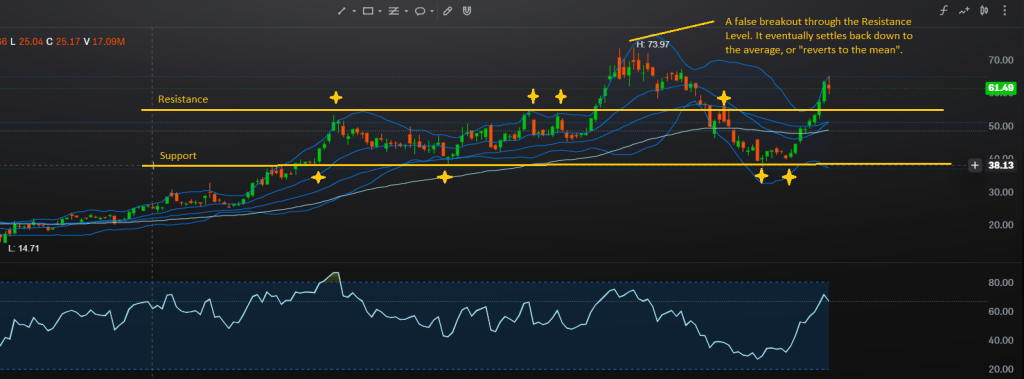
Using the power of indicators that I laid at your feet back in September’s post, you can spot the levels of support and resistance, and this can help you choose a strike price or plan your next move by seeing where price is likely to NOT go.
Below is a chart to show you what I mean. I’ve labeled the support and resistance levels as well as each time the price tested those levels and bounced off them with little sparkles. There are several ways in which to use this information when trading.
For example, there seems to be strong support at the $38 price, as once it broke through that price it has never dipped below it. So you could sell a Cash Secured Put with a strike price of $38 or lower and feel pretty confident in that.
Neat, huh?
And when it’s time for leavin’, I’ll hope you’ll understand
Alrighty, well I reckon that wraps up this month’s sermon.
Let us pray.
Lord, I pray that some of this technical jargon made sense to this congregation gathered here today. Bless my jokes so that they may all land in accordance to Your will. Forgive us our short-sided trades and lead us not into margin calls.
Forever and ever, until the closing bell. Amen.
Go in peace, Chris
Lend as little as $25 to create a more equitable world.Donate directly to the poor.
If you’d like to give trading on Robinhood a try you can click my referral link HERE and we’ll both get some free stock.
Further Education
Here’s a quick video explaining Cash Secured Puts. This guy is a straight-shooter and doesn’t put out flashy content.
This guy is a little more on the trading guru spectrum, but he does give really good advise and explains things clearly. This is a longer video but it will breakdown the whole process even more if you’re jonesing for it. Just don’t pay for a course or anything.
Whattup?! Hope everyone is doing well. Let’s kick it.
All In
I’ve made around 150 trades so far this year and have only lost 4 of them. I think it’s time to crank it up and put my money where my mouth is.
So this month I started dumping every last cent I made into my brokerage account. I’ve even been donating plasma twice a week for a few years that pays an additional $500 a month, and all that goes in, too. It also doubles as a great time to read! Quick, easy, and painle…
What’s funny is the first half of the year I added almost no extra capital and solely traded with what was in there. Depositing nothing and withdrawing nothing. Now I put everything in, withdraw what I need, and I couldn’t be happier with the results. I even reached my monthly goal in the first week! (Spoiler alert: I reached my monthly goal on my first trading day in September)
In my experience money seems to work better when it’s transitional and being put to good use. It doesn’t like to be hoarded, static, and gathering dust. It likes to flow, it likes to be active and used honorably. This leads to less clinging and I don’t wind up being a dragon alone in my cave protecting a pile of gold that I have no need for.
There’s a parable where a master going on a journey entrusts his possessions to three servants. Two of them invest and double it, the third is too yellow-bellied and buries his. The master returns, praises the first two and punishes the third for letting his fear lead to his inaction. His money is taken away and given to one of the faithful servants.
We need to be accountable with our gifts, talents, and resources and use them for the benefit of others.
Live life with an open hand. Accept what is given and freely give.
Margin
If you have $2k in your brokerage account and meet certain criteria (or pretend that you do) you can trade on margin. Margin is just stock-talk for a loan. It allows you to purchase more than you could with your own cash, using your existing investments as collateral. If you have $5000 worth of stocks, for example, they will let you borrow an additional $2,500 at 5.75% interest, which ends up being around $0.40 per day. Not too shabby!
Let’s use a very modest example. If my portfolio was boring and growing at 8% per year and my margin loan costs 5.75%, I pocket the spread while still spending borrowed cash. This is called arbitrage and I’ll post a video down at the end if you want to see how someone uses this to have stocks pay for themselves over time.
Growing a small account can be pretty tricky and can take a long time if you’re playing things safely. Margin can give you a jump start by amplifying your profits and losses! You can even withdraw this margin to your bank account to spend how you please. In fact, borrowing against investments is exactly what the wealthy do! This avoids taxes because you don’t sell anything to get access to your money while also allowing you to stay invested.
(The margin rate drops to 5.5% in Sept)
Shifting Mindset
Until now my goal has been to simply grow the account, not live out of it. This is the first month that I’ve ever actually pulled money from it so this is a drastically different game plan for me. I’m switching from building up a stockpile to trading for income.
Last year I got out of debt the same week my truck died forcing me to buy another vehicle. I also happen to have a knack for buying something that will need a new transmission within the first week of purchase. So I went from debt-free, to buying a new car, then buying a new transmission for it in the same week.
All that to say, that $6000 transmission had to go on a credit card which has gotten a little out of control now that it’s had a year to snowball while I continue to use it. Surely someone can relate?
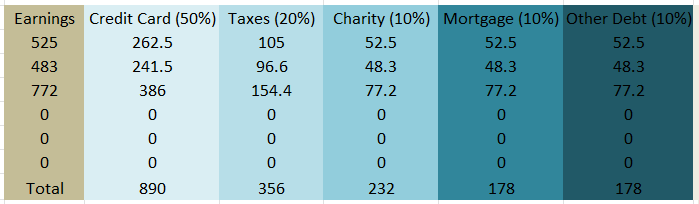
So my plan of attack is to take 100% of my profits from my brokerage account and heavily attack that bill along with some additional categories. I even made a spreadsheet that calculates everything for me when I punch in my profit!
The reason I’m only accounting for profits in my brokerage account is because I cannot withdraw from my retirement account.
You can see that as of starting this 3 weeks ago I’ve already been able to put almost $900 towards that credit card debt! And the way I see it I made that money by clicking a few buttons on my phone. Pretty rad if you want my honest opinion.
I have other categories that will move in once the debt gets paid down and I’ll increase the percentage of some of the pre-existing ones, but this debt gotta go.
This has been no small task. I’ve had to switch all my bills over, figure out how all this margin stuff works, and get used to seeing my bank account with $15.00 in it. Ok, well maybe I was used to seeing that already BUT I’M THE BANK NOW BABY!
Charity
This feels tricky to talk about so I’m just gonna try and speak as honestly as I can. My giving is coming from a genuine desire to help, not from a desire for recognition or praise. It’s also serving as an act of faith on my part. So don’t even talk to me about it.
On our first date Becky and I shared our biggest flaws with each other. I answered selfishness probably a little too hastily. (The anniversary of this date happens to be the same day I’m posting this.)
I can also tend to do quite a lot of living from a “scarcity mindset”, as they say, that can act the same as selfishness in it’s behavior. I can get overwhelmed with the sense that I need to gather and hold onto everything because I’m going to lose it all someday. I act as if I lack something.
Behind all the worry what I’m really saying is that I don’t have enough and I don’t have faith that the things I need will be provided for me in the future, though that has absolutely been the case up till this point.
The ugly truth is I’m rarely satisfied unless I take the time to recognize that my cup actually overfloweth all over the damn place.
I started donating to Give Directly in January and was just giving a small, fixed amount each month. Money was tighter then as we were just coming out of the holidays followed immediately by 3 big birthdays in my family. It was at this same time that I also stopped depositing money into the market.
I was punched in the soul at work one day with the realization that I’m just working frantically to fill my own barn with plans to build another so I could fill that one, too, and suddenly found my self crying in the corner of the greenhouse.
There have been several times where I’m casually looking at huge profits on my screen and still find myself wanting more. I’ll close out a huge win and instantly go on the hunt for another. Recently I’ve realized that a year ago I would have been in an ecstatic state of bliss over these wins. Now I’ve grown used to them and I want bigger numbers.
“Whoever loves money never has enough; whoever loves wealth is never satisfied with their income. This too is meaningless”. Ecclesiastes 5:10
So obviously I’m just chasing the green dragon here and needed to change my, “WHY”.
This has led me to discovering a unique way to give that has already brought me a lot of joy and feels more involved. Kiva is a microlender that connects you with people around the world allowing you to lend them money to help with a wide range of needs.
Let me introduce you to my first 2 friends.
Rufino is from the Philippines and is the caretaker of 5 young kids. He’s been in the pig raising business for 6 years and it’s how he provides for his wife and family. He was just asking for $75 for feed and supplements for them big boys and that just so happened to be what I was there to spend that day!
Rosemary is a widow and a farmer from Kenya. Their annual income is $1,800 and she’s having a tough time with her crops which she solely relies on to meet her family’s needs. So some bloke from England and I got her fully funded.
What I really like is that these loans are paid back so that the cash pool can really grow over time. The money is recycled so you’re able to lend a hand countless times.
I started teaching my son to invest at the beginning of the year and this month we started trading options in one of his accounts. He’s already made $345 in his first 3 trades. Crazy. But this poor dude is exactly like me so I’m trying to head him off at the pass and nip some of the shortcomings we share in the bud.
So I’ve decided to treat his account just like mine. Any money he makes goes into his account to invest, he pulls out what he needs, and gives to charity based off a percentage. I can only hope that instilling that not everything is intended for you early on will help him along his way.
Continuing with the honesty, giving is not easy for me and I think that’s the point. A sacrifice is not something that’s easy to hand over. When I made my spreadsheet I didn’t include the charity column at first and told myself that after the debt was paid down I would add it while still keeping my small monthly donations going. I even convinced myself with the oxygen mask analogy from airplane travel. Gotta take care of yourself before you can help others.
Ultimately I got punched again and decided against that. I cancelled my small monthly donation to GiveDirectly and started giving on a larger percentage of my earnings instead. Now the plan is when my debt is paid off I will up that percentage to a larger one.
I like the analogy of arising tide lifts all boats over the airplane oxygen mask one.
Giving and receiving are the same thing. You gotta let some of it go to get the good stuff.
Through my whole stumbling journey I’ve learned that I’ve needed boundaries like this to keep myself from getting out of control. I tend to do all things to the extreme.
Roth & Roll!
If we’ll remember, a Tarot card told me to get my shit together last month which led me to finding $12,300 in an old IRA from a previous job! Now let me tell ya, it’s been a doozy and a half to get this money moved over, and I’ll spare you all the details (except that they mailed the check to a very old address for starters), but when it’s all said and done it’ll be 2 months from the time I found it until I can get it moved over and start trading with it.
This thing only grew, like, 1.4% over the entire 10 year period. So it didn’t even beat inflation. I’ve heard horror stories of people not checking their retirement accounts until it’s too late. Most people don’t realize that their retirement accounts are investments in the stock market, they just think it’s some magical savings account. Even more so, sometimes you need to go in and specify how you want that money managed. I have no idea how mine was set up but the account only grew a hair over $100 in 10 years.
Go check your accounts, please.
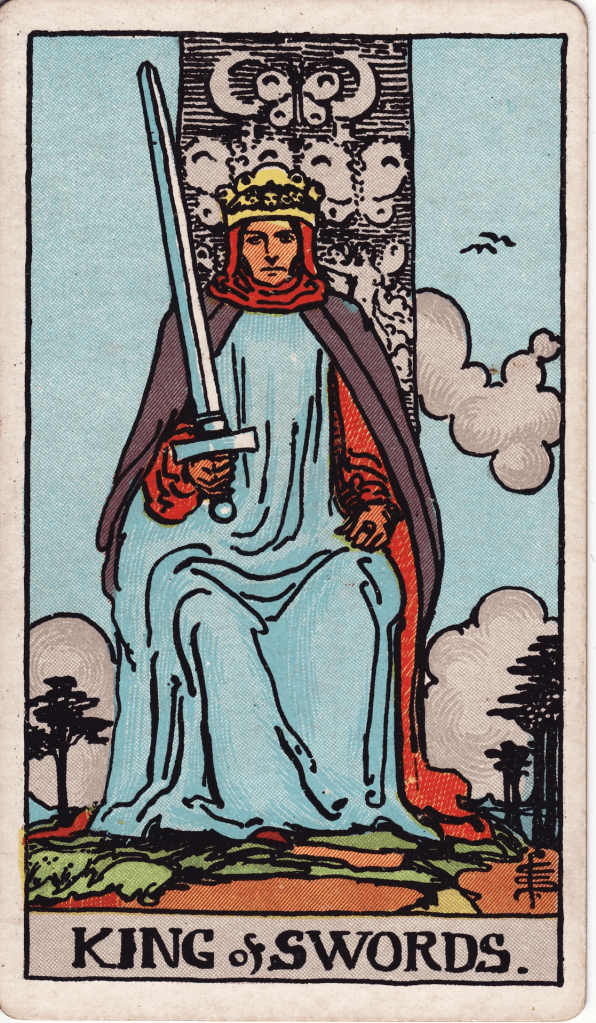
Now I’m not a full-fledged King of Swords yet, but I’m on my throne and inching ever closer.
Knights of the WrapITUPALREADY!!!
My monthly goal is to increase my accounts by 5-10%. In August I achieved an increase of 31.86% bringing in $2,581 total.
I’m up 110% this year increasing my accounts by $9,992 so far in the year of our Lord 2025. The S&P 500 has only returned 5.5% in this same timeframe.
If you’ll recall, last month I changed my monthly goal to accommodate a range instead of a fixed percentage. A goal of 5-10% vs the goal of 10% we had all grown to love. The decision to go all in with my whole paycheck was one of the main factors behind that. Also, now that the account is in flux constantly, a monthly percentage isn’t that helpful or accurate of a statistic.
To put some things in perspective, if you put your money into the S&P 500 you can expect to get an averaged return of somewhere between 7-8% a year.
Now I want to lay out 2 scenarios for you.
Scenario 1: I put $20,000 in the market, I drive to work, and 30 years later, with an 8% yearly return, I’m sitting on $201,000. Easy peasy.
Scenario 2: I put $20,000 in the market, but I’m a hot shot option trader with groovy, long hair and impeccable comedic timing. I get a return of 8% a month and in 30 years that’s $21.6 quadrillion. No goofin’ that’s the real math.
Now this may come as a huge surprise to you… but I am the hot shot trader from Scenario 2 and there’s no way that’s a feasible plan. Even with my perfect hair forever.
I’m not trying to fly too close to the Sun here. A little wing clipping does me some good sometimes before I get a little too ahead of myself.
Tldr: this gives me some breathing room, takes off a little pressure, and could prove hard to keep up with now that I’m dumping my whole paycheck in. Don’t be surprised if I stop listing monthly percentage all together.
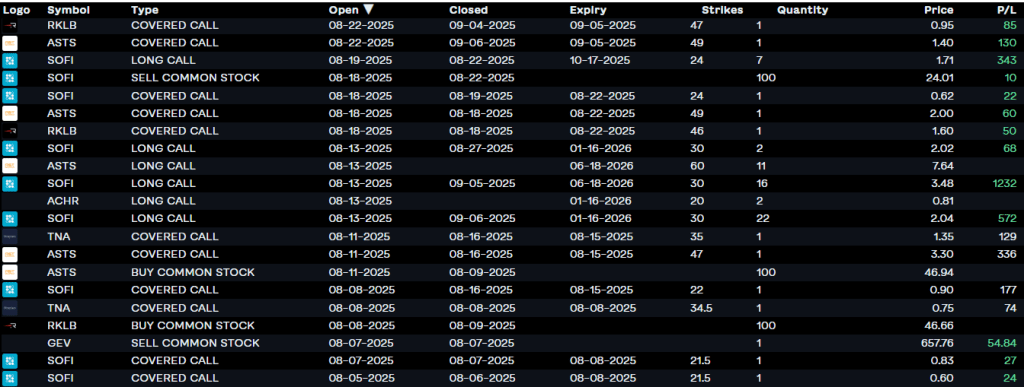
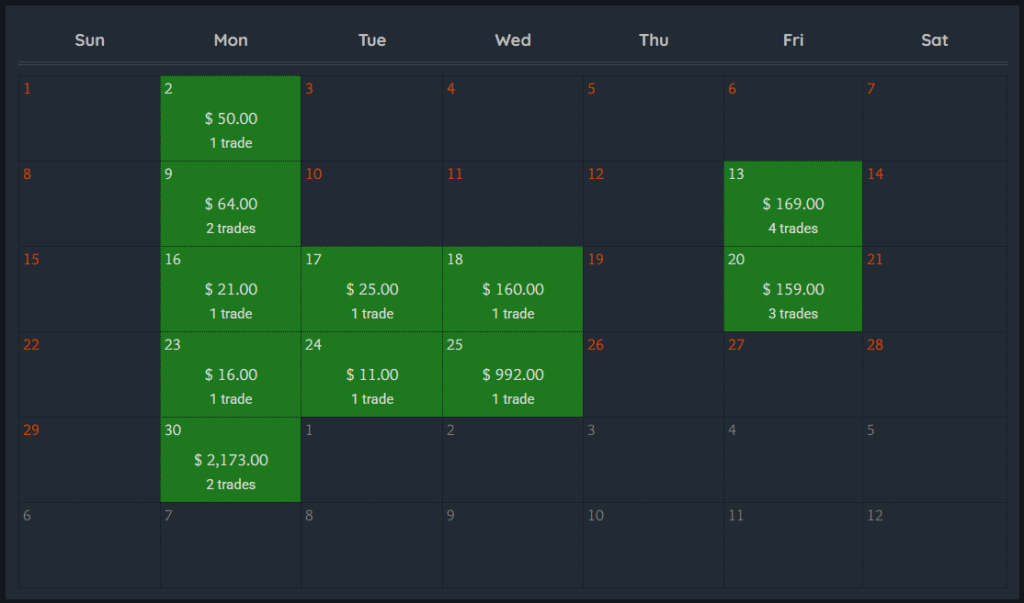
Profit and Loss Calendar for August.
Here are the trades.
Clicking the image will take you to my Theta Gang profile where you can view all of my trades with more details and notes.
Here’s a table of my monthly performance compared to the S&P 500’s.
Profit
% Change
S&P 500
Jan
$1214
+13.7%
+2.7%
Feb
$1741
+16.85%
-1.42%
March
$339
+2.8%
+5.75%
April
$182
+1.46%
-0.76%
May
$459
+3.64%
+5.9%
June
$3840
+38.6%
+5%
July
$757
+4.5%
+2.2%
August
$2580
+31.86
+1.91
Oh Boy, There’s More?!?!
Welcome to the VIP LOUNGE.
Recently I’ve opened up even more by showing my whole account balance and making some videos as sometimes it’s just easier to show what I’m working with and talk it out.
In the first video both my kids went to the wrong school on their first day and I made $460 in the process of getting them to the right ones while selling in the money covered calls in standstill traffic.
Selling an “in the money” (ITM) covered call is a strategy that seems counterintuitive at first because it almost guarantees you will sell your stock. However, it is a deliberate move used for specific purposes, primarily to generate a large, immediate premium and to lock in money now. That’s a solid plan if I’ve ever heard one.
The longer I’m in the market the more I learn the value of a bird that’s already in your hand being worth more than the two birds that are slated to beat their quarterly projected growth with a 11% expected swing either way after earnings in the bush.
Here’s how this plays out. I know, I’m sorry for trying to explain a strategy at the end of such a long post, I’ll be brief.
In this strategy I’m buying stock then opening a contract to sell it at a lower price because I’m paid a lot of money to do that. This isn’t the way I, or most people, would usually trade covered calls. You normally offer to sell for a price above what you paid while mostly hoping that it doesn’t reach that price so you get to keep your shares and your premium.
Let’s say I see a stock that I believe is going up. I purchase 100 shares at $40 each. I sell a covered call that offers to sell the shares for $38 but I’m paid $350 for that option. If it continues to rise I lose $200 in the difference from my price paid vs price sold leaving me with $150 profit. Kinda funky, huh? I like it.
Here’s a video of me walking you through some trades where I execute this strategy. You might notice that I now flippantly trade a stock that I’ve anguished over in the past after the shares were called away. People can change.
In this video you get to see how some of my trades play out over the course of a whole week. You’ll see the good and the bad days along with even more thoughts from my head.
Alright, I’ll let you go.
If you’ve stumbled across my little ole site and you’re looking to get started, feel free to reach out and I’ll see if I can get you pointed in the right direction. There’s a plethora of info out there but I’ve noticed through teaching other interests of mine that people’s problems feel very authentic to them and it can be reassuring to have someone talk through a specific question or issue.
Thanks, as always, for stopping by! Chris
You can be notified when I post by subscribing here on WordPress to receive an e-mail or you can follow me on Instagram which comes with some free jokes that I workshopped all month.
The video below is the one I discussed earlier in the Margin section, and he is actually the guy that got my gears turning on investing with my entire paycheck. He does things entirely differently as he buys dividend paying stocks with his paycheck, which then pay for themselves over time. If you are less risk-averse you might want to look into something like this.
If you’re interested you can research some ETFs like SPYI, QQQI, & XDTE.
If you’d like to give trading on Robinhood a try you can click my referral link HERE and we’ll both get some free stock. Or don’t use the referral I don’t care, just get started if you haven’t already.
Please remember that not a dedgum thing on this site is financial advice.
My monthly goal is to increase my accounts by 10%. In June I achieved an increase of 31.86% bringing in $3,840 total.
I’m up 83% this year increasing my accounts by $7,575 so far in the year of our Lord 2025. Even though it’s been on a tear and recently hit an all time high, the S&P 500 has only returned 5.5% in this same timeframe.
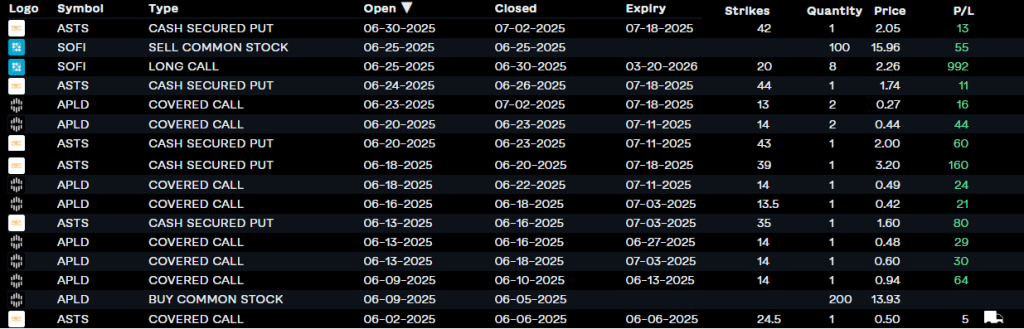
Profit and Loss Calendar for June.
Here are the trades.
Clicking the image will take you to my Theta Gang profile where you can view more details and notes.
Here’s a table of my monthly performance compared to the S&P 500’s.
Profit
% Change
S&P 500
Jan
$1,214
+13.7%
+2.7%
Feb
$1,741
+16.85%
-1.42%
March
$339
+2.8%
+5.75%
April
$182
+1.46%
-0.76%
May
$459
+3.64%
+5.9%
June
$3,840
+38.6%
+5%
Calls to the Wall
Alright, so how did I make over $3000 this month?
Well it allll began way back in March when I started buying Long Calls (aka LEAPS) on SOFI.
Now if you think a stock is going to go up and you don’t want to buy shares, LEAPS (Long-term Equity AnticiPation Securities) are what you’re looking for. You can think of them as a stock replacement. The game plan is to buy contracts at a low price and sell them at a higher price. Simple enough.
In this situation the difference between buying a LEAP and buying 100 shares was $150 vs $1,500 with SOFI. I’m able to control around the same amount of shares, depending on the contract selected, for a fraction of the cost! That’s leverage, baby!!
In my Roth IRA I purchased 18 of these $150 contracts over the course of the year. I sold them all for $270 each bringing home $2,160!
Once I noticed a lot of momentum I got brave and bought some more LEAPS in my brokerage account. I bought 8 at an average price of $226 and 5 days later I sold them for $350 making another $992 in profit.
Here’s what the position looked like in one of my Robinhood accounts towards the end. You can see I’m holding 18 contracts with an average cost of $1.50. That’s actually $150 because contracts “control” 100 shares, so you must multiply by 100. The value of the contract grew by $1.11 and now the current price is $2.61. That difference is multiplied by how many contracts I own and that’s my profit minus fees.
$261 – $150 = $111 $111 x 18 = $1998
No Free Lunch
The trick is these bad boys have expirations so you must be correct on many factors like volatility and time, not just price movement, to be profitable. That’s why I tend to buy them at least 1 year out to expiration giving me plenty of time to be wrong. And for a while I was wrong as they were down 50% for a minute and there’s always the possibility of losing the total amount of capital that you put in when you buy options. In this case that would’ve been thousands of dollars. These contracts didn’t expire until March, I just chose to take profits now to be safe.
But, admittedly, it wasn’t without a fight. It took the counsel of 2 people close to me to gently remind me that I had a wild look in my eyes and that it didn’t seem like I was following my rules.
Artist’s Rendition
Just a few days before, there I was happy and content about the trade being up $200 only to find myself being a greedy little pig wanting even more as I was sitting on $3000 in profits. That’s a dedgum 90% return on my investment and I was still wanting to squeeze out more juice! How ungrateful!
This is just another time when I’m reminded that trading is almost completely a mental game and I must not be swayed by emotions.
Now in full transparency had I stayed in the trade I would have actually made several more thousand dollars at this point and that leaves me with a choice between being grateful for the $3000 I just made or dwelling on what could’ve been. Ultimately I made the right decision by sticking to my rules and I have no regrets. I’ve already started loading up on new contracts that expire 2.5 years from now.
I mostly sell options so that I’m paid to open contracts. Buying them is much more risky and, you know, costs money so I prefer selling Cash Secured Puts on stocks I wouldn’t mind owning and selling Covered Calls on stocks I own at a price I’m willing to sell at. But done correctly LEAPS can be very powerful and will be something I utilize more from now on.
Alright… but fool me THREE times…
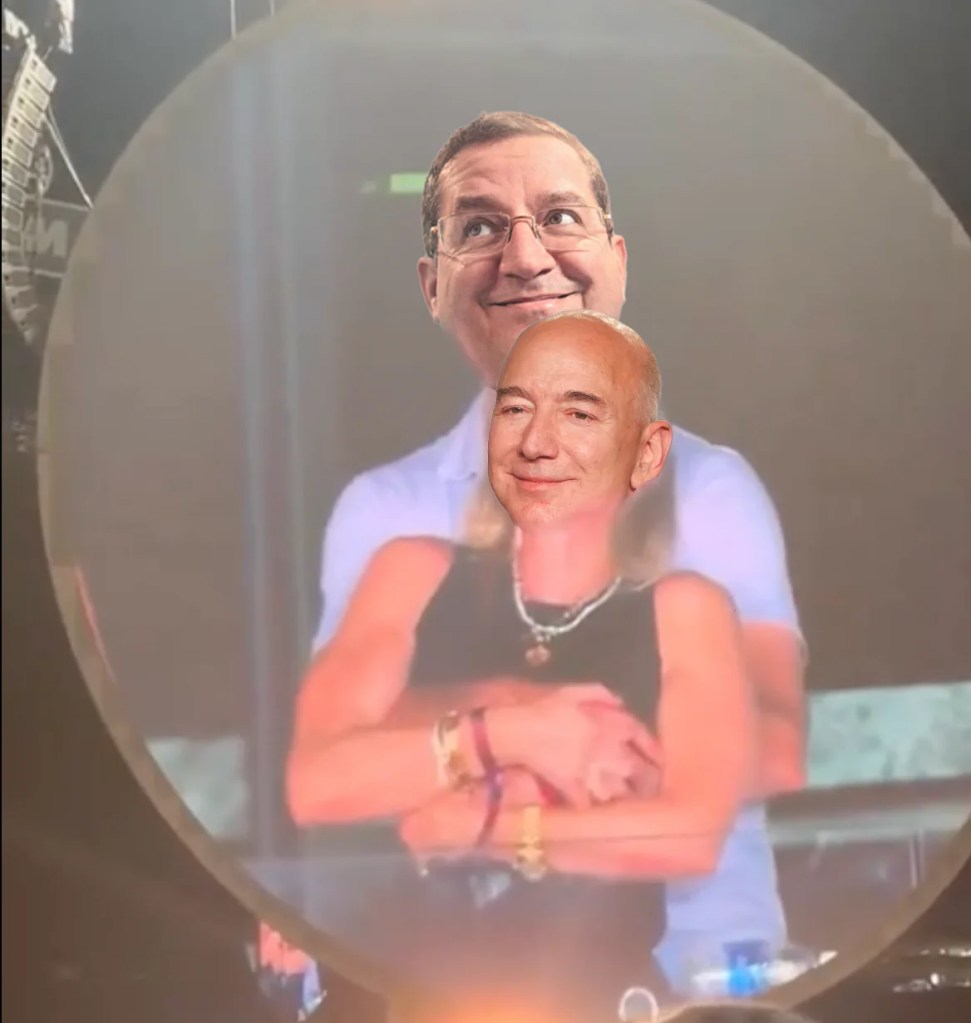
Some good news followed by a picture with Jeff Bezos and the CEO of AST SpaceMobile being posted caused a stir and made all my precious shares get ripped out of my arms again. This is the second time this has happened to my favorite stock.
I had to sell them at $24 while the stock shot to $50. That’s around $3000 of opportunity loss because I was Selling Calls in low volatility environment on a stock I didn’t particularly want to get rid of at that price. Funny how obvious things are in hindsight when you say them out loud.
I turned around and sold 4 Cash Secured Puts on ASTS in total making $324. I changed my strategy on this as I was selling puts while the stock price was rising this time around. I normally sell puts when the price is going down because I’m paid more premium to do so. Selling puts while the stock price goes up puts the odds in my favor even more with the trade off being less premium being paid to me.
But if I sell puts on a stock that is ripping upwards my chances of winning are greatly increased, the only downside is I’m paid less premium. And because I was so very correct these trades were only open for 2-3 days each allowing me to rinse and repeat.
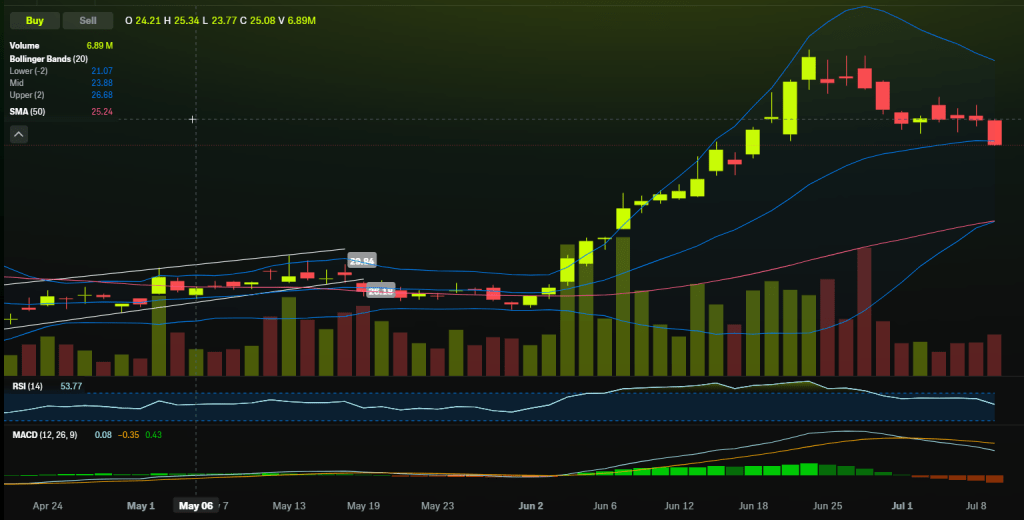
AST SpaceMobile (ASTS) going back to April.
Honestly, this was a very trying time for me. Seeing my favorite stock get called awayagain while it rockets off truly hurts. Psychology says FOMO is more painful than loss.
Ultimately I have paused on Selling Puts on ASTS because it’s in a downtrend and I’m not trying to catch a falling knife. This stock has mooned then gradually slid back down to where it was before. I just have to be patient and hope it does the same this time. I’ve made this mistake in the past and see people wiser than I do it all the time…
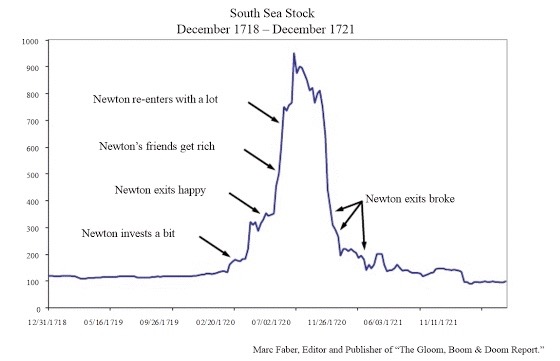
… People like Sir Isaac Newton! A couple of months ago I quoted him as saying,
“I can calculate the motion of heavenly bodies, but not the madness of men.”
– Sir Isaac Newton, sore loser.
The quote is a reminder of the importance of understanding human psychology in speculating financial matters and he said it after he lost a fortune in the South Sea Bubble. Long story short, Newton makes a lot of money, lets FOMO get the best of him, then loses everything.
Its helping me hold a strong resolve as I fight the temptation of getting back into a stock that I think is priced too high, especially for a pre-revenue company, along with a price movement that was unwarranted by the news. I know nothing but my gut is telling me to wait and let the dust settle.
If I sell a Cash Secured Put with a strike price of $44 and the stock continues to drop back to the $22 range, that misjudgment just cost me $2,200 in unrealized losses and a lot of frustration. I’m attempting to avoid that and wait for confirmation that the stock is trending back up. It’s this new thing I’m trying that doesn’t involve gazing into a crystal ball.
Feel free to shoot any questions or comments my way.
Live Laugh Leverage
Chris
Oh, we also went on a week’s vacation to D.C. this month. Here’s video proof.
If you’d like to give trading on Robinhood a try you can click my referral link HERE and we’ll both get some free stock.














 Moses of the South